Uniforms and PPE
Civil protection path
What's in the store, who's wearing it, and what's about to expire. It's the section nobody looks at until an inspection turns up.
The store
Every item has a code, the available sizes, the unit cost and two numbers that work together: current stock and minimum stock. When stock falls below the minimum, the item surfaces on the dashboard. It doesn't warn you when it's gone: it warns you when it's about to go, which is the only moment you can still do something.
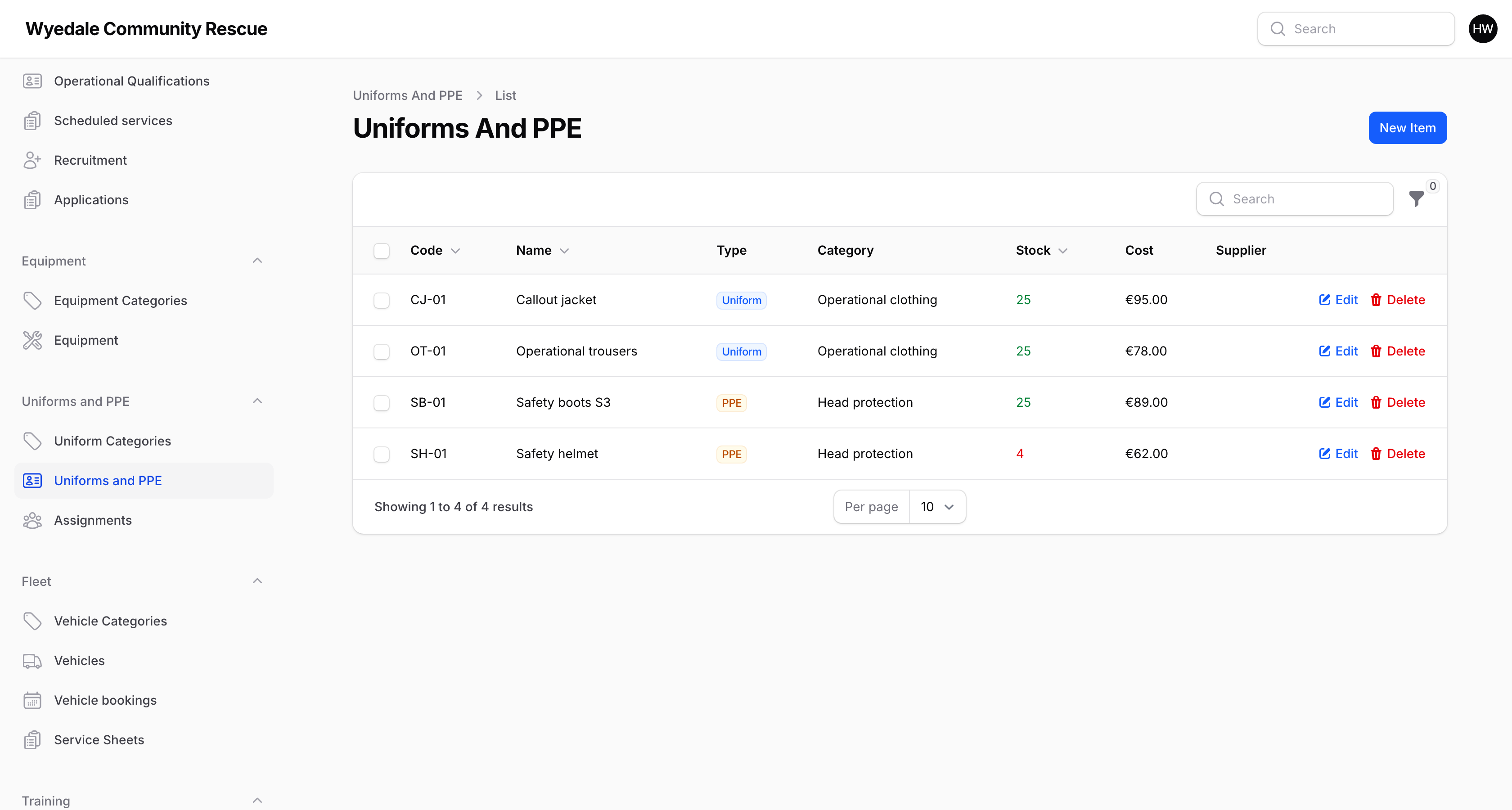
Categories separate clothing from actual protective equipment. The distinction matters: PPE has an expiry date and a standard behind it; a polo shirt doesn't.
Issuing
When you issue an item to a volunteer, the store draws down by itself. Their record keeps what they hold, since when, and in what size — so when someone leaves the association you know exactly what has to come back.
On return you record the condition: new, good, fair, damaged, lost. A damaged item doesn't go back into stock as if nothing happened.
PPE expiry
A helmet, a harness or a pair of insulating gloves have a life declared by the maker. The expiry date sits on the issued item, not on the catalogue entry: two helmets of the same model issued in different years expire at different times.
Anything approaching expiry ends up on the dashboard, with the rest.
Where to start
Load the items you actually issue, with a realistic minimum stock. Past issues can go in as you go: you don't need to reconstruct history before you start.